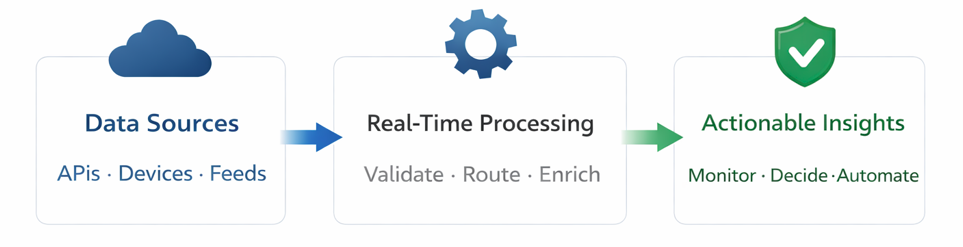
Practical applications across modern business operations
Every day, thousands of operational events occur across business systems, cloud services, connected devices, and applications. A single event rarely explains what is happening on its own. Understanding operations comes from bringing those events together.
Collecting this information is only the first step. Its real value lies in understanding what is happening as events unfold and using that knowledge to support timely decisions. This challenge can be found across many industries. Although organizations operate in different ways, they often face the same question: How can continuous streams of operational events be transformed into timely and informed action?
Monitoring Changing Conditions
Many business activities depend on conditions that can shift throughout the day. Weather is one example. Changes in temperature, rainfall, or severe weather can affect transportation, logistics, construction, and field services. Timely updates allow teams to adjust plans before changing conditions begin to affect operations.
Understanding Connected Devices
Connected devices provide a continuous view of physical operations. Whether monitoring industrial equipment, environmental conditions, or connected infrastructure, these devices generate a constant stream of operational events. Processing this information as it arrives helps organizations identify unusual behavior, improve maintenance planning, and reduce unnecessary downtime.
Responding to Business Events
Business applications also generate a continuous stream of operational events, from customer transactions and service requests to application updates and system notifications. Processing these events in real time helps teams stay informed, coordinate more effectively, and respond sooner when business conditions change.
Although these situations differ, they all share the same requirement: the ability to understand operational events while they remain relevant. Whether the information comes from a weather service, a connected device, or a business application, timely insight supports better operational decisions.
This practical challenge continues to shape the KSO initiative at Babstech. Our focus is on enabling a structured flow of operational data so organizations can better understand what is happening across their operations, improve operational visibility, and respond with greater confidence.
Why This Matters
Organizations are becoming more connected, and operational data continues to grow in both volume and variety. Responding effectively requires more than simply collecting information. It requires the ability to process operational events while they remain relevant. Real-time capabilities help organizations improve responsiveness, enhance operational efficiency, and support more informed decision-making.
Looking Ahead
In our next release, we will explore what it takes to support real-time operations as operational data volume continues to grow.
Stay Connected
Babstech remains committed to developing practical, scalable approaches to modern data processing and operational visibility.
Subscribe
Follow our journey for future updates and perspectives on the KSO initiative.